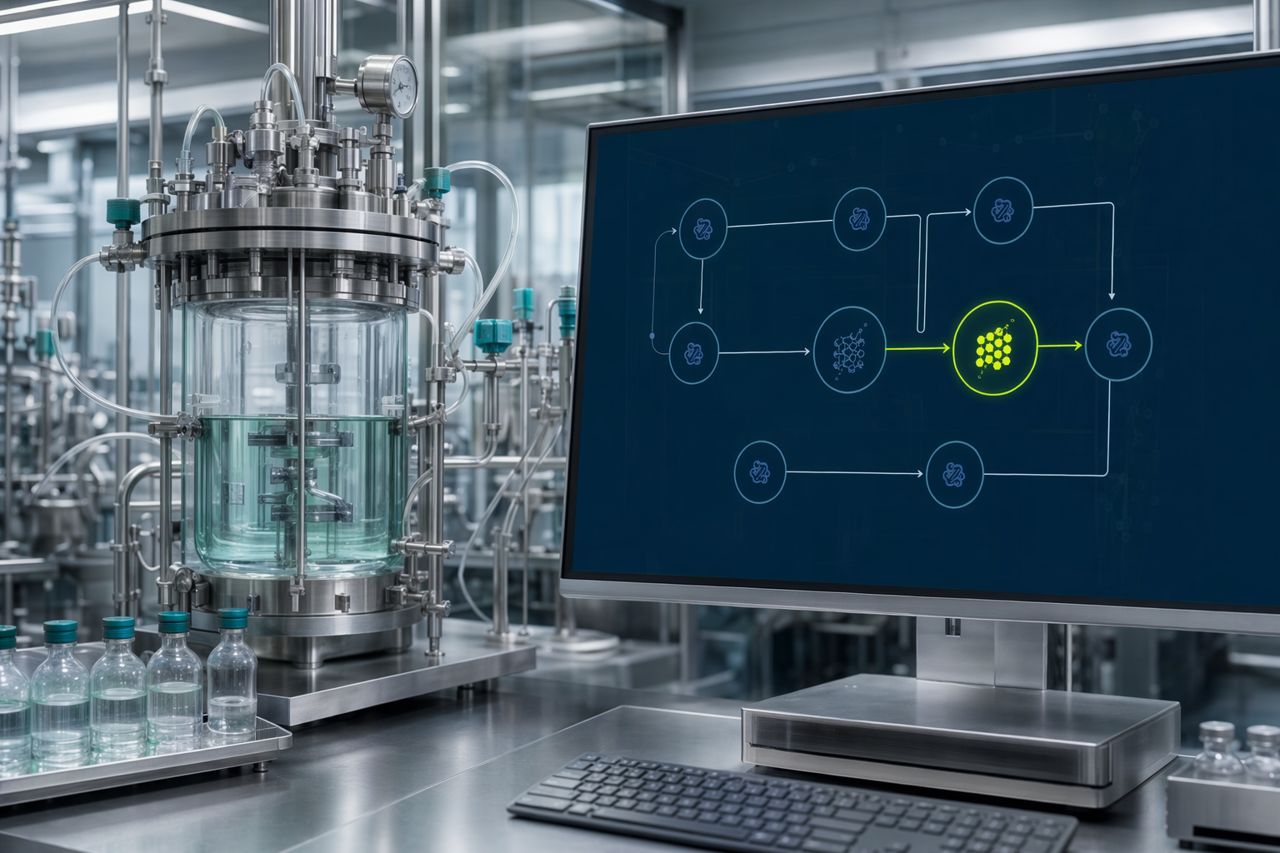
Pharma Process Enzyme Sourcing Checklist
When an enzyme becomes part of an API route, the sourcing decision affects more than price and lead time. It influences stereochemical outcome, impurity strategy, batch consistency, documentation readiness, and the ability to move from development to campaign manufacture without avoidable rework.
Enzymestech supports pharmaceutical API manufacturers, CDMOs and biotech companies, and the resellers who supply them, sourcing enzymes for biocatalytic steps where route fit, impurity control, supply confidence, and validation-aware documentation are central to qualification.
Use this checklist to evaluate an enzyme supplier for pharmaceutical biocatalysis before locking the route.
Wholesale and bulk supply, quote only. For manufacturers, resellers and biotech companies. In your inquiry, name the product or enzyme class, the quantity (trial amount and expected campaign volume) and the destination. Pack size, price and lead time are quoted per order. Request a quote
1. Confirm the enzyme fits the API route, not just the reaction class
A promising biocatalyst is not automatically a manufacturing-ready fit. The sourcing conversation should start with the route conditions your process team intends to preserve.
Check for route compatibility
- Substrate and intermediate structure alignment
- Desired stereochemical outcome and selectivity expectations
- Solvent, cosolvent, pH, and temperature window compatibility
- Tolerance to substrate load, product inhibition, and process impurities
- Fit with upstream and downstream unit operations
- Compatibility with isolation, crystallization, or extraction strategy
Buyer value
A route-fit review reduces the risk of late-stage enzyme replacement, impurity surprises, and process changes that can affect validation timelines.
2. Evaluate impurity control early
For API manufacture, enzyme selection should be connected to the impurity control strategy. The supplier should understand that conversion performance, selectivity, and side-product behavior must be evaluated in the context of the route.
Ask the supplier to discuss
- Known or expected side reactions under proposed process conditions
- Formation of regioisomeric, stereoisomeric, or hydrolysis-related impurities
- Carryover considerations from enzyme preparation into downstream processing
- Residual protein and process-related impurity expectations
- Compatibility with the intended purge strategy
- Support for documenting impurity rationale during development
Buyer value
Impurity-aware sourcing helps process chemists avoid enzymes that look suitable in early screening but create avoidable analytical, purification, or filing burden later.
3. Verify supply confidence before scale-up pressure begins
Bulk enzyme sourcing for pharmaceutical biocatalysis should be assessed before the process reaches campaign demand. A supplier should be able to discuss supply reliability in operational terms, not vague availability claims.
Confirm supplier readiness
- Bulk supply path from development quantity to production demand
- Expected lead time range and campaign planning requirements
- Batch-to-batch consistency controls
- Change notification expectations
- Backup production planning where applicable
- Storage, handling, and transport requirements
- Packaging formats aligned with plant use
Buyer value
Supply confidence protects route continuity, purchasing forecasts, and manufacturing schedules when an enzyme becomes a critical raw material for an API step.
4. Review documentation before qualification
Documentation gaps can slow vendor qualification even when the enzyme performs well. For pharmaceutical API manufacturers, the sourcing package should be reviewed early with process, quality, and regulatory stakeholders.
Documentation to request
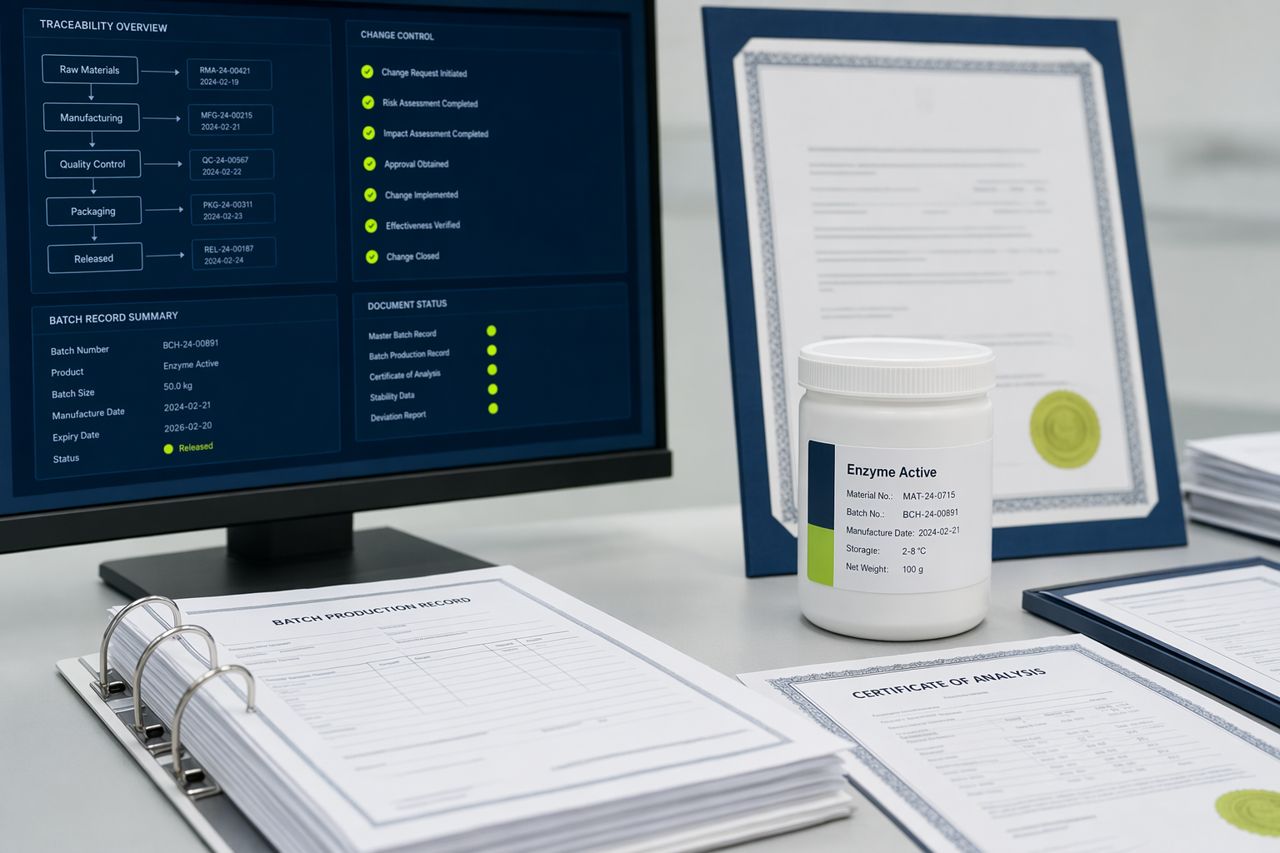
- Product specification and quality statement
- Certificate of analysis format
- Lot traceability information
- Manufacturing origin and biological source information where applicable
- Allergen, animal-origin, and GMO-related statements where applicable
- Safety data sheet
- Storage and shelf-life guidance
- Change control and notification position
- Support statements for regulatory or customer filings where appropriate
Buyer value
A documentation-ready supplier helps reduce qualification friction and gives internal teams the information needed to assess risk before the route is committed.
5. Match enzyme format to the plant environment
The best enzyme for a reaction may still need the right physical format and handling profile for the manufacturing site. Discuss how the enzyme will enter the plant, how it will be charged, and how it will be removed or managed downstream.
Format and handling questions
- Liquid, powder, immobilized, or custom preparation needs
- Dust, containment, and operator handling considerations
- Compatibility with charging sequence and reactor configuration
- Mixing, mass transfer, and viscosity considerations
- Downstream removal or carryover expectations
- Cleaning and equipment turnover implications
Buyer value
Format alignment reduces plant adaptation work and helps process chemists design an enzyme step that is practical for GMP-adjacent or GMP manufacturing environments.
6. Assess technical support quality
A qualified enzyme supplier should contribute technical judgment without overstating certainty. For API route development, support should be practical, data-oriented, and aligned with process decisions.
Look for support in
- Screening strategy and enzyme family prioritization
- Interpretation of reaction performance trends
- Route-specific process condition recommendations
- Troubleshooting low conversion, selectivity drift, or inhibition
- Suggestions for stabilizing the process window
- Scale-up discussion with process chemistry and manufacturing teams
Buyer value
Strong technical support shortens the path from enzyme hit to manufacturable step and reduces the burden on internal teams when timelines are compressed.
7. Compare suppliers using qualification risk, not only unit price
For pharmaceutical API manufacturers, the lowest quoted enzyme cost is rarely the full process cost. A better comparison includes route risk, impurity burden, documentation readiness, supply reliability, and support quality.
Supplier comparison criteria
| Criterion | What to confirm | Why it matters |
|---|---|---|
| Route fit | Conditions, selectivity, downstream compatibility | Reduces late process redesign |
| Impurity control | Side-product and carryover discussion | Supports analytical and regulatory strategy |
| Supply continuity | Bulk path, lead time, change control | Protects campaign planning |
| Documentation | Quality, traceability, origin, safety information | Supports vendor qualification |
| Technical support | Screening, troubleshooting, scale-up input | Accelerates development decisions |
| Plant readiness | Format, handling, storage, cleaning considerations | Improves manufacturing practicality |
8. Plan the path from screening sample to bulk supply
An enzyme raw material is a process input that your team qualifies inside the route, the quality system and the regulatory strategy; it is not a finished API component. Agree the path from first sample to repeat bulk orders before the route is locked.
A typical engagement follows a controlled technical path:
-
Route and substrate review Your team shares the transformation target, substrate class, selectivity requirement, process constraints, and preferred procurement timeline.
-
Candidate enzyme recommendation Enzymestech identifies enzyme options that match the transformation type and expected process window.
-
Sample supply for internal evaluation Small evaluation quantities can be arranged for route screening, process fit, and impurity assessment under your internal protocols.
-
Technical procurement alignment We support documentation review, packaging requirements, supply forecast discussion, and quality expectations.
-
Bulk supply and repeat order planning Once an enzyme raw material is selected, Enzymestech supports scale-up quantities, lot planning, and repeat procurement coordination.
What to ask for in the procurement file
Available documentation depends on enzyme type, grade, intended use, and supply stage. Procurement files typically draw on:
- Product identity and lot traceability information
- Specification and release documentation
- Safety documentation for handling and storage review
- Manufacturing and supply chain summary information where available
- Recommended storage and transport conditions
- Change notification and continuity planning discussion
- Technical data summaries for process evaluation
- Sample-to-bulk supply pathway and lead-time guidance
Enzyme families covered by this checklist
- Transaminases for chiral amine synthesis and asymmetric amination routes
- Ketoreductases and alcohol dehydrogenases for selective carbonyl reduction and chiral alcohol formation
- Lipases and esterases for kinetic resolution, selective esterification, hydrolysis, and protecting group strategies (see lipase for API chiral resolution)
- Nitrilases and amidases for selective conversion of nitriles and amides to acid or amide intermediates
- Oxidases and oxygenases for selective oxidation steps where chemical alternatives may create impurity, safety, or waste challenges
9. What to include in a quote request
A precise RFQ helps Enzymestech evaluate enzyme fit and respond with a relevant sourcing path.
Recommended RFQ details
- Target transformation and desired stereochemical outcome
- Substrate, intermediate, or representative structure where shareable
- Development stage: route scouting, process development, validation preparation, or commercial supply
- Expected annual or campaign demand range
- Preferred enzyme format and packaging needs
- Key process constraints: solvent, temperature range, pH range, substrate load, or downstream limitations
- Impurity concerns already identified
- Documentation required for supplier qualification
- Required delivery timeline and destination region
- Whether you buy as a manufacturer, CDMO, reseller or biotech company
If confidentiality is required before technical disclosure, indicate that in the request.
Why API manufacturers work with Enzymestech
Enzymestech supplies enzymes for pharmaceutical biocatalysis with a focus on practical route implementation. We support process chemists and sourcing teams evaluating enzymes for chiral transformations, selective conversions, and manufacturing-relevant biocatalytic steps.
Enzymestech support areas
- Wholesale and bulk enzyme supply for pharmaceutical API routes, quoted per order
- Enzyme selection aligned with route conditions
- Development-to-scale sourcing planning
- Documentation support for vendor qualification
- Technical discussion with process chemistry teams
- Packaging and handling alignment for manufacturing use
We keep the sourcing process technical, concise, and validation-aware.
Request a quote
If you are qualifying an enzyme for an API process step, send the route requirements, scale expectations, documentation needs, and target timeline through the on-site form. For the fastest response, name the product or transformation, the quantity and the destination.